
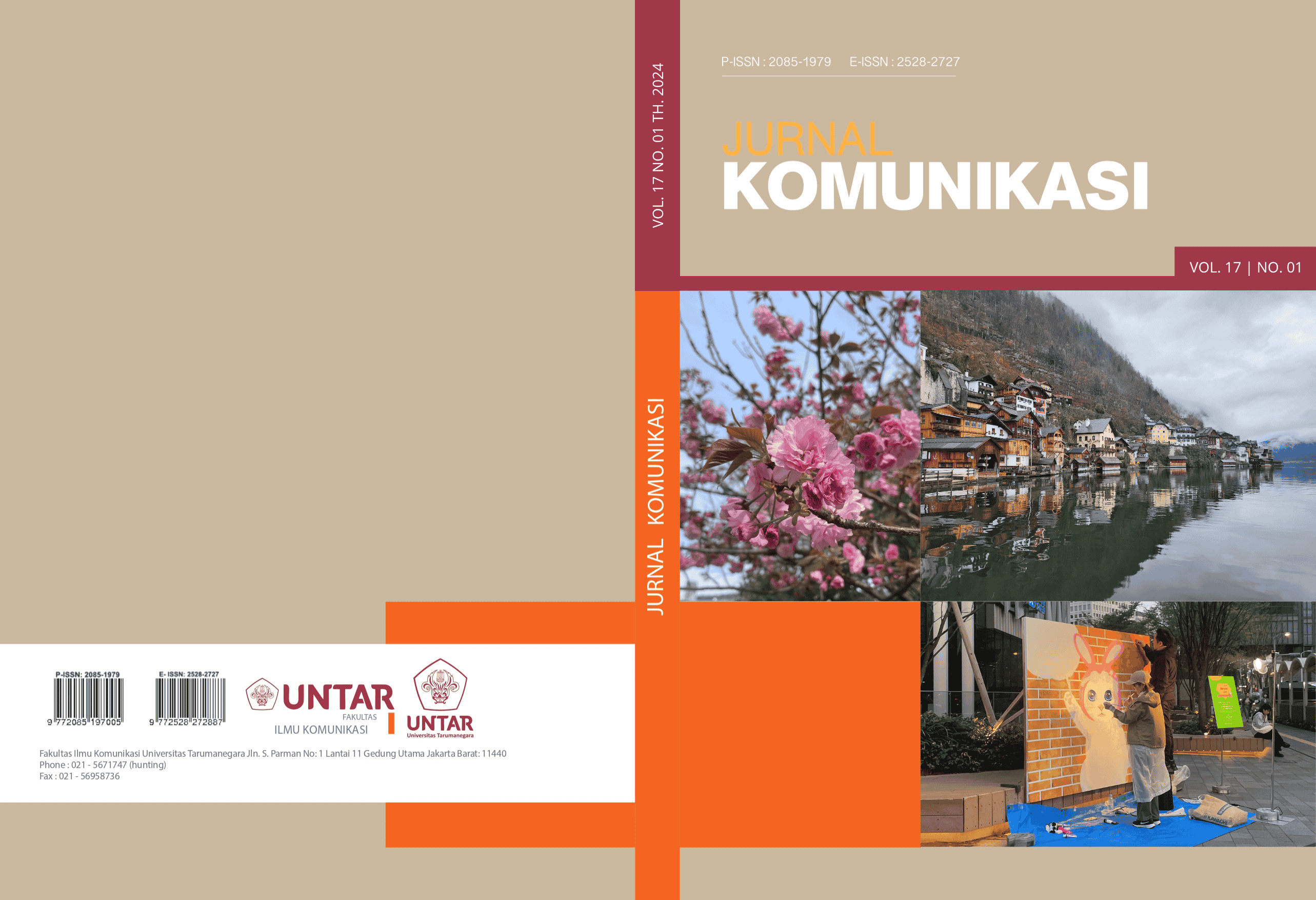
The Role of Social Media as a Guide and Reference During Travel: Case Study on Indonesian Millennial Tourists in Japan
Article Sidebar
 Read Counter : 194
 Download : 135

Main Article Content
Abstract
Social media plays a central role in travel planning, particularly among Indonesian millennial tourists who seek information, inspiration, and real-time guidance. This study examines how social media shapes the behavior of Indonesian tourists visiting Japan, employing the framework of digital tourism communication and the theory of electronic word-of-mouth (eWOM). A mixed-methods design was applied, combining a survey of 494 respondents with in-depth interviews to explore travel habits, digital engagement, and decision-making processes. Findings reveal that Instagram and TikTok serve as primary triggers of travel inspiration, while YouTube, blogs, and Google Reviews are primarily used for information verification and detailed itinerary planning. User-generated content (UGC) is perceived as more credible than commercial content, underscoring the importance of authenticity and trust. However, the viral nature of social media also contributes to overtourism, highlighting the need for sustainable destination management strategies. Theoretically, this study advances the literature by linking UGC, flow experience, and travel decision-making in the context of a developing country. Practically, it provides recommendations for destination managers, policymakers, and service providers to leverage social media strategically while promoting responsible and sustainable tourism practices.
Article Details

This work is licensed under a Creative Commons Attribution-ShareAlike 4.0 International License.
This work is licensed under a Jurnal Komunikasi Creative Commons Attribution-ShareAlike 4.0 International License.References
Cahyani, D. (2023). The Influence Of Instagram Micro-Influencers Factor Toward Customer’s Interest And Intention To Visit In Tourism Sectors. Syntax Transformation, 4(9), 2023.
creswell. (n.d.).
Dai, F., Wang, D., & Kirillova, K. (2022). Travel inspiration in tourist decision making. Tourism Management, 90, 104484. https://doi.org/10.1016/j.tourman.2021.104484
Filieri, R., Alguezaui, S., & McLeay, F. (2015). Why do travelers trust TripAdvisor? Antecedents of trust towards consumer-generated media and its influence on recommendation adoption and word of mouth. Tourism Management, 51, 174–185. https://doi.org/10.1016/j.tourman.2015.05.007
Gössling, S. (2017). Tourism, information technologies and sustainability: an exploratory review. Journal of Sustainable Tourism, 25(7), 1024–1041. https://doi.org/10.1080/09669582.2015.1122017
Indonesia Millennial Report. (2024). Indonesia Millennial Report 2024. https://cdn.idntimes.com/content-documents/indonesia-millennial-report-2024.pdf
Jog, D. R., & Alcasoas, N. A. (2023). Travel decision making through blogs and vlogs: An empirical investigation on how user-generated content influences destination image. Turyzm/Tourism, 33(2), 19–28. https://doi.org/10.18778/0867-5856.33.2.02
Kaplan, A. M., & Haenlein, M. (2010). Users of the world, unite! The challenges and opportunities of Social Media. Business Horizons, 53(1), 59–68. https://doi.org/10.1016/j.bushor.2009.09.003
Klook Travel Pulse. (2025). Klook Travel Pulse 2025. https://www.klook.com/newsroom/travelpulse-2025-ultimatetherapy/
Liu, C., Jiang, M., & Muhammad, Z. A. (2024). The impact of TikTok short video factors on tourists’ behavioral intention among Generation Z and Millennials: The role of flow experience. PLOS ONE, 19(12), e0315140. https://doi.org/10.1371/journal.pone.0315140
Mariani, B., Baggio, A., & Fuchs, C. (2022). Business intelligence and big data in hospitality and tourism: a systematic literature review. Journal of Business Research. https://doi.org/10.1016/j.jbusres.2021.10.018
Mayasari Soeswoyo, D., & Rahardjo, S. (2020). Studi Komparasi Perilaku Wisatawan Nusantara Generasi-X dan Milenial Era Revolusi Industri 4.0 di Indonesia. Tourism Scientific Journal, 6(1), 110–126. https://doi.org/10.32659/tsj.v6i1.131
Muhtadi, A. (2023). Exploring Tourism Experiences a Qualitative Approach to Analyzing Tourist Motivations. Eastasouth Proceeding of Humanities and Social Sciences, 1(01), 79–86. https://doi.org/https://doi.org/10.58812/ephss.v1i01.40
Nam, K., Dutt, C. S., & Baker, J. (2022). Authenticity in objects and activities: Determinants of satisfaction with virtual reality experiences of heritage and non-heritage tourism sites. Information Systems Frontiers, 25(3), 1219–1237.
Ratten, V., & Braga, V. (2019). Tourism innovation. Journal of Hospitality and Tourism Management, 41, 171–174. https://doi.org/10.1016/j.jhtm.2019.10.002
Rodríguez-Torrico, P., Prodanova, J., San-Martín, S., & Jimenez, N. (2020). The ideal companion: the role of mobile phone attachment in travel purchase intention. Current Issues in Tourism, 23(13), 1659–1672. https://doi.org/10.1080/13683500.2019.1637828
Sigala, M. (2018). Social media and customer engagement in the context of collaborative value co-creation: a conceptual framework for research and practice. Tourism Management, 59, 165–177. https://doi.org/https://doi.org/10.1080/13683500.2015.1091442
Stylianou-Lambert, T. (2012). Tourists with cameras:. Reproducing or Producing? Annals of Tourism Research, 39(4), 1817–1838. https://doi.org/10.1016/J.ANNALS.2012.05.004
Sutrisno, R., Rafdinal, W., Septyandi, C. B., Gaffar, M. R., & Susanto, E. (2024). Disentangling Digital Influences on Tourist Behavior: The Role of Trust and Destination Image in the Social Media Era. Journal of Tourism, Hospitality and Travel Management, 2(2), 129–142.
Wayan, N., Pinaria, C., Gusti, I., Febrianto, A., & Anggani, M. F. (2023). Millennial Generation Preferences for the Use of Technology in Improving Livelihood Experiences in Accommodation Services. 2(3). https://journal.uinmataram.ac.id/index.php/juwita
Xiang, Z., Magnini, V. P., & Fesenmaier, D. R. (2015). Information technology and consumer behavior in travel and tourism: Insights from travel planning using the internet. Journal of Retailing and Consumer Services, 22, 244–249. https://doi.org/10.1016/j.jretconser.2014.08.005
Zhou, Q., Sotiriadis, M., & Shen, S. (2023). Using TikTok in tourism destination choice: A young Chinese tourists’ perspective. Tourism Management Perspectives, 46, 101101. https://doi.org/10.1016/j.tmp.2023.101101